
Home » flooring-installation » flooring-installation/carpet-floor-installation

New Carpet That Feels Soft, Stays Tight, and Wears Well for Years

Carpet is still the most popular flooring choice for bedrooms, family rooms, and upstairs hallways. It is warm underfoot, absorbs sound between floors, and comes in dozens of colors, textures, and fiber types. When it is installed with the right padding, stretched properly, and seams in the correct spots, it stays smooth and wrinkle-free for 10 to 20 years.
We install plush, Berber, frieze, textured, patterned, and carpet tile for homes and offices across Cameron Park and El Dorado County. We also handle old carpet removal, padding replacement, subfloor repair, stair fitting, and all transition work.
Every project starts with a free on-site visit. We measure your rooms, check the subfloor, and walk you through the carpet options that fit your traffic level, budget, and style. You get a written quote before any work begins.

What Goes Into the Carpet Under Your Feet

Carpet is made from thousands of fiber loops or tufts pushed through a backing material and held in place with a secondary layer of latex or adhesive. The fibers create the soft surface you walk on. The backing gives the carpet its shape and strength.
Here are the parts that matter most when choosing carpet:
We check the delivered carpet rolls using a carpet face weight density gauge before every installation. This tool clamps onto a 1-inch sample and reads the fiber density in ounces per square yard. We compare the reading against the manufacturer’s stated face weight to confirm the carpet matches what was ordered. This verification step follows ASTM D5848 Standard Test Method for Mass Per Unit Area of Pile Yarn Floor Covering, which sets the laboratory-grade procedure for measuring carpet pile weight. Carpet that falls below the stated face weight gets flagged before it goes on the floor, because low-density carpet wears through faster in high-traffic areas like hallways and stairs.

Plush, Berber, and Frieze Are Three Different Carpets for Three Different Jobs

Plush (Saxony) has a smooth, even surface with cut fibers that all stand straight up. It feels soft and looks formal. It works best in bedrooms, guest rooms, and low-traffic areas. The downside is that it shows footprints, vacuum marks, and wear patterns more than other styles.
Berber (loop pile) has uncut fiber loops that create a flat, textured surface. It is one of the most durable carpet styles because the loops resist crushing and bounce back after traffic. Berber works well in family rooms, hallways, and offices. The downside is that snags from pet claws can pull loops and create runs.
Frieze (twist) has tightly twisted fibers that curl in different directions. The twisted texture hides footprints, pet hair, and light stains better than plush or Berber. Frieze is a good all-purpose carpet for living rooms, playrooms, and homes with kids and dogs. It holds up well in medium to high traffic areas.
We help you pick the right style based on the room, the traffic level, and whether you have pets or young children.

our Carpet Floor Installation service include

The Padding Under Your Carpet Decides How It Feels and How Long It Lasts

Carpet padding is the cushion layer between the carpet and the subfloor. Most homeowners never see it, but it does more work than the carpet itself. It absorbs impact, reduces noise, insulates against cold, and protects the carpet backing from grinding against the hard subfloor.

Here are the main padding types we install:

We test every padding delivery using a carpet padding compression tester before it goes on the floor. This tool applies a set amount of pressure to a padding sample and measures how much it compresses. We compare the compression reading against the manufacturer’s stated density rating to confirm the padding meets spec. This quality check follows El Dorado County Building Department Residential Construction Standards Section 5.3.1 Floor Covering Underlayment, which requires all carpet underlayment installed over occupied spaces to meet minimum sound transmission and impact insulation ratings. Padding that compresses too far under load will bottom out within a year, making the carpet feel thin and worn even when the fibers are still in good shape.

Carpet That Handles Spills, Pets, and Kids Without Staining

Stain resistance comes from two sources: the fiber itself or a topical treatment applied after manufacturing.
Solution-dyed nylon is the most stain-resistant carpet fiber available. The color is baked into the fiber during production, not applied to the surface. That means spills, bleach, and pet accidents cannot strip the color out. Solution-dyed nylon is the top choice for homes with large dogs, young children, or high foot traffic.
Stain-treated polyester has a chemical coating applied to the fiber surface. It blocks most liquid stains if they are cleaned up within a few hours. Polyester is softer and less expensive than nylon, but the stain treatment wears off over time with cleaning and foot traffic.
We carry both options. For homes in Cameron Park with pets, we recommend solution-dyed nylon with a moisture-blocking pad underneath. For bedrooms and guest rooms with lighter use, stain-treated polyester gives you a soft feel at a lower price.

Carpet on Stairs and Hallways Takes Extra Skill and Better Material

Stairs and hallways are the hardest areas to carpet. The carpet bends around nosing, wraps over risers, and gets more foot traffic per square foot than any other room.

Here are the main padding types we install:

For hallways, we plan the seam placement so the seam falls in a low-visibility area. We power-stretch the full length and use a seam iron to bond the joint. A tight hallway seam should be invisible when the carpet is finished.
We recommend Berber or frieze for stairs and hallways because they resist crushing and hide wear patterns.

Carpet Tile and Broadloom for Offices, Retail, and Medical Spaces

Commercial carpet is built for heavier traffic, rolling loads, and frequent cleaning. We install two types:
Carpet tile (modular squares): Individual 18-inch or 24-inch squares glued directly to the subfloor. Easy to replace one tile at a time if it stains or wears out. Works well in offices, waiting rooms, and retail stores.
Commercial broadloom (rolled carpet): Continuous carpet in 12-foot rolls, glued down with full-spread adhesive. Used in large open spaces, conference rooms, and hospitality settings.
We schedule commercial installs after hours or on weekends to keep your business running. We also handle ADA-compliant transition strips at doorways and between different floor types.

What Sets Our Carpet Installations Apart

We Power-Stretch Every Room

Most carpet problems come from poor stretching. We use a power stretcher on every room over 12 feet. That is the difference between carpet that stays flat for 15 years and carpet that wrinkles in 3.

We Match the Carpet to How You Live

Pets and kids get stain-resistant nylon. Bedrooms get plush with thick padding. Basements get moisture-blocking pads. We pick the fiber, pile, and padding for each room.

We Know Cameron Park Homes

Hot summers that dry out tack strips. Cold winters that shift raised foundations. Builder-grade carpet from the 1990s that was never properly stretched. We have worked in these homes for over 20 years and know what to expect.

We Handle Everything in One Project

Removal, disposal, subfloor repair, padding, carpet, stretching, seaming, transitions, and cleanup. One crew. One timeline. One price.

We Work Clean

We cover doorways, protect your walls, and vacuum every room before we leave. Your home is ready to use the day we finish.

From Bare Subfloor to Finished Carpet in Five Steps
Carpet installation follows a set order. Each step builds on the one before it. Skipping steps or rushing through the stretching creates wrinkles, buckles, and loose seams that show up within months.
01
Remove the old carpet
We pull up the existing carpet, padding, tack strips, and staples. We bag and haul everything away so the subfloor is completely clear.
02
Check and repair the subfloor
We walk the floor and look for soft spots, squeaks, popped nails, and moisture. On plywood subfloors, we screw down loose panels and patch damaged areas. On concrete slabs, we check for moisture and flatness.
03
Install new tack strips and padding
We nail fresh tack strips around the perimeter of each room, about half an inch from the wall. Then we lay the carpet padding across the floor and staple it down. The padding stops at the tack strips so the carpet can hook onto the pins.
04
Cut, lay, and stretch the carpet
We roll the carpet out, rough cut it to size, and position it over the padding. Then we hook one edge onto the tack strips and use a carpet power stretcher with tail block to pull the carpet tight across the room. The power stretcher uses a long pole with a padded head that pushes against the far wall while the stretcher arm pulls the carpet toward the tack strips on the near side. This creates 1% to 1.5% stretch across the full width, which is what keeps the carpet flat and wrinkle free for years. This method follows CRI 104 Standard for Installation of Commercial Textile Flooring, the Carpet and Rug Institute's installation standard that requires power stretching (not just knee kicking) for all broadloom carpet installations over 12 feet in any direction. Cameron Park homes built in the 1980s and 1990s often have original carpet that was only knee-kicked, which is why wrinkles appear after 5 to 10 years.
04
Seam, trim, and finish
We use a seam iron and seam tape to join carpet pieces where two rolls meet. We trim the edges along the walls, tuck the carpet behind the tack strips, and install transition strips at doorways. Then we vacuum and do a final walk-through with you.

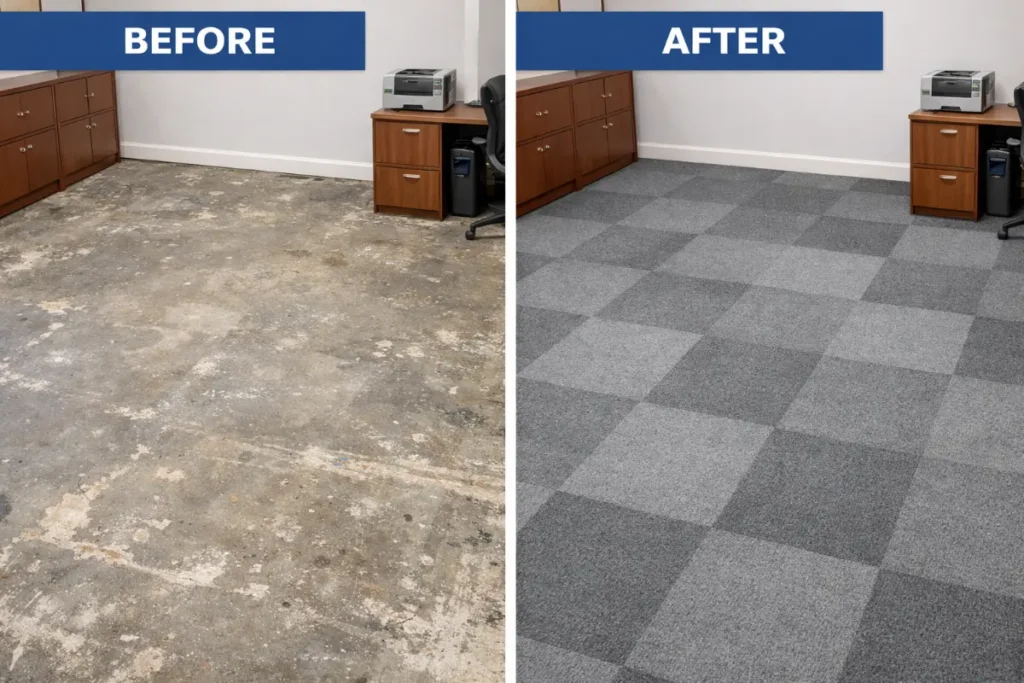
Durable Composite Flooring Installation – Before & After Photos

This photo documents a tile carpet floor installation in the same space before and after service. The before image shows an exposed, worn concrete floor, while the after image shows newly installed carpet tiles with a clean, consistent pattern. The change reflects a standard, realistic installation result without altering the surrounding environment.

Ready for Carpet That Feels Right and Stays Smooth?

Whether you need plush carpet in the bedroom, Berber in the family room, or carpet tile in the office, we can help. We will check your subfloor, walk you through the options, and give you a straight price with no hidden charges.
Call (916) 365-4251 to set up your free carpet consultation. Or fill out the form below and we will get back to you within one business day.

Carpet Installation for Homes and Offices Across El Dorado County

We install carpet flooring in:

Each community has different home ages, subfloor types, and traffic patterns. We adjust the carpet type, padding density, and installation method for each home.

Carpet Questions Cameron Park Homeowners Ask Us

How much does carpet installation cost in Cameron Park?
The typical range is $3.50 to $7.50 per square foot installed. That includes carpet, padding, labor, and old carpet removal. Stair work and premium padding push the price higher. We give free on-site estimates with a written quote.
One room usually takes half a day. A full home (3 to 4 bedrooms plus hallways) takes one to two days. Stair work adds extra time. We give you a timeline before we start.
Solution-dyed nylon with a moisture-blocking pad. The color is built into the fiber, so pet accidents and cleaning chemicals cannot strip it out. Pair it with a moisture-blocking pad to stop liquid from soaking through to the subfloor.
Berber has uncut loops that resist crushing and hide dirt. It works best in family rooms, hallways, and offices. Plush has cut fibers that stand straight up for a smooth, soft feel. It works best in bedrooms and low-traffic rooms. Berber is more durable. Plush is more comfortable.
For most rooms, 7/16-inch thick padding with 8-pound density is the standard. Bedrooms benefit from thicker, softer padding. Stairs need thinner, firmer padding so the carpet wraps tightly around the nose. We match the padding to the room.
Yes, if the surface is flat, dry, and structurally sound. We lay tack strips around the perimeter and install padding over the hard surface. This protects the floor underneath in case you want to expose it later.
We can move most furniture for a small fee. If you want to save on labor costs, move small items (lamps, electronics, breakables) yourself before we arrive. We handle large pieces like beds and dressers.
Yes, with the right setup. We install a moisture-blocking pad over the concrete slab and use Berber or carpet tile that handles humidity. We test the slab moisture level first to make sure the environment is safe for carpet.
Most residential carpet lasts 10 to 15 years with regular vacuuming and periodic deep cleaning. High-traffic areas like hallways and stairs may need replacement sooner. Premium fibers with high twist counts last longer.
Yes. We hold a California CSLB C-15 Flooring and Floor Covering specialty license. We carry full general liability and workers’ compensation insurance. You can verify our license on the CSLB website.